
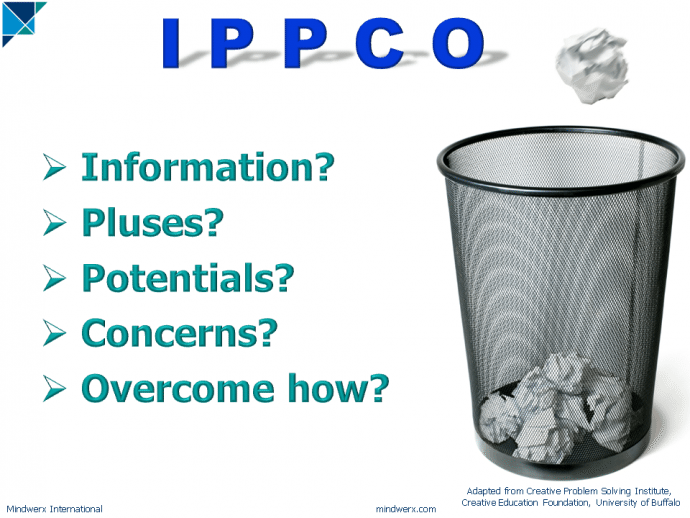
 IPPCO can be used for a number of purposes. It is first a great exploratory tool in the Creative Problem Solvingprocess, that opens up your thinking and guides you to more useful ideas.
It is also used to help strengthen promising ideas into potential solutions and send them into the implementation phase with a better chance of success. IPPCO is simple guide to critical thinking, with each letter representing a thinking action:
Information – What information is available and/or needed on this idea or focus?
Pluses – What are the pluses of the current situation or budding idea, what benefits, what value does it add, why do it?
Potential – If we improved this situation or implemented this idea what might it lead to, what potential flow-on is there?
Concerns – What concerns are there now about the current situation, or the idea being presented, what might go wrong, what barriers, who might resist it?
Overcome – How might we overcome these problems or concerns, what ideas do we have to address it or what would build on the idea’s potential?
IPPCO is based on the CPSI (Creative Problem Solving Institute) PPCO model – we added I for information to better explore the focus.
Creative Problem Solving with IPPCO
When faced with an emerging problem, the instinct of many is to jump straight in and ‘fix’ the problem, and often this is prudent and valuable. On occasion though more critical thinking is needed, particularly when working as a team, and IPPCO is a simple easy to use Mind Tool to get you started.
I – Information
Start by getting as much information on the problem as possible. Look beyond the obvious flaws and failures that are appearing. Get relevant background information, current trends or changes in the process, people, equipment, materials, procedures etc involved. Don’t fall into ‘paralysis by analysis’ but get the relevant and reliable information the team might need to consider the situation as fully as possible.
P – Pluses
Often when problems appear we see only the negative aspects, but we also need to understand what is working and what is of value. Look now at what is happening to determine what is working, what is still of value, what wouldn’t you want to lose in any changes you make. Don’t risk as they say ‘throwing the baby out with the bathwater’.
P – Potential
Many times when problem solving we simply ‘fix’ the problem, when in fact we have an opportunity to improve the process. Take a few minutes to look at the situation afresh and see what potential might be gained by not just bringing it back to specification, but by making it better. This will open you up to creative new ways of looking at the problem.
C – Concerns
Now is the time to look for the weaknesses, flaws, design failures in the process that created the problem. Also look at the impact the current problem is having – if systems are down, or customers are complaining you need to work on these first. Emergency issues come first, improvements follow. Get clarity on the concerns that need to be rectified, and if needed use the Pareto Principle (80/20 Rule) to prioritise what concerns need to be worked on first. Maybe try a FIP – First Important Priorities.
O – Overcome How?
Okay, now you are ready to generate ideas to solve the problem, and hopefully improve the process so the problem does not recur. Set your focus for idea generation, targeting specific areas that need ideas. Don’t scatter-gun your thinking, focus specifically on high priority high potential concerns. Use creative thinking tools such as Brainstorming, Lateral Thinking and other ideation tools to first generate lots of ideas.
No one tool or framework will solve serious problems, but by taking even a few minutes to do some critical thinking, and design your Creative Problem Solving approach you will significantly enhance your chances of success and that pays big dividends. Good Luck.
To help you learn more about Creative Problem Solving Mindwerx offers courses in Critical & Creative Thinking.